Top Finds On Amazon


TL;DR: Standing out on Bumble is mostly a photo problem, not a personality problem. Your first photo does the majority of the work, your prompts decide whether a like turns into a conversation, and Bumble’s 24 hour reply window means a dead profile costs you matches faster than it does on other apps. Fix the first photo, cut the group shots, and write prompts that give someone an actual opening.
Bumble punishes a lazy profile more than most apps, because the structure forces a conversation quickly. Whoever opens has to find something to open with. If your profile gives them nothing, the match quietly expires and you never see it again.
This is the full profile job: photos, prompts, bio, and the settings people leave on default without realising what they are doing.
How to stand out on Bumble: the short answer
Lead with a clear, well lit, solo photo where your face fills a decent part of the frame. Use six photos minimum, all different settings. Answer three prompts with specific details rather than jokes about being bad at bios. Then make sure your profile gives someone an obvious thing to ask you about.
Start with the first photo, and be ruthless about it
Everything else is secondary. On a phone screen your first photo is roughly the size of a beer mat and it is being judged in under a second.
Rules that do the most work:
- Solo. No group shots as the first photo, ever. People will not play spot the difference.
- Face clearly visible. No sunglasses, no hat brim shadow, no side profile.
- Shot from chest up or waist up. Full body shots from twenty feet away read as hiding.
- Natural light, taken outside or near a window. Overhead indoor lighting is unflattering on everyone.
- Someone else took it. Front camera selfies are the most common first photo and among the worst performing.
- A real expression. Not a smoulder. A slight genuine smile beats a serious face for almost everyone.
Bumble’s own guidance encourages members to make the first photo a proper standout image rather than a casual snap, and the app has repeatedly nudged users towards clearer, brighter, solo lead photos. It is not a coincidence that this is the one piece of advice every app gives.
If your photos are the weak point, this covers the fix in detail: https://ultimateguidetodating.com/how-to-get-better-photos-for-your-dating-profile/ and https://ultimateguidetodating.com/what-photos-work-best-on-dating-apps/
The photo set, in order
Six to nine photos, each doing a different job.
- The clear face shot. Covered above.
- A full body shot. Standing, natural, decent light. Leaving this out makes people assume the worst.
- You doing something. An actual activity you actually do. Climbing wall, kitchen, gig, bike, dog walk.
- A social photo. One group shot, no more, and you should be obviously identifiable in it.
- Somewhere with context. Travel, a city, a landscape, something that suggests a life happening.
- A slightly less posed one. Laughing, mid conversation, caught rather than arranged.
What to cut: gym mirror shots, car selfies, photos with a filter that changes your face, anything with an ex cropped out, and any picture more than two years old.
Prompts are where Bumble matches are actually won
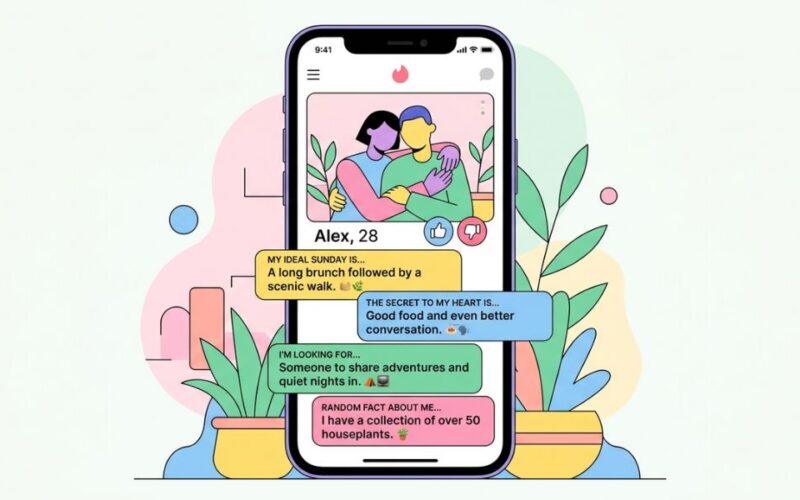
Bumble profile prompts are the difference between a like and a conversation. The app’s structure means someone has to open, and most people will not bother if there is nothing to grab.
Bad prompt answers are vague or self deprecating. “I’ll never shut up about: my dog.” Fine. Forgettable. Nobody can reply to it.
Good prompt answers do one of three things:
- Give a specific detail. “I’ll never shut up about: the fact my dog is scared of the bin lorry but not of fireworks.”
- Leave an obvious hook. Something slightly odd that begs a question.
- Ask something answerable. A question they can respond to in ten seconds.
Three well answered prompts beat six lazy ones. Pick the ones you actually have something to say about, and rewrite anything you would be bored to read.
The bio
Short. Three lines. Specific.
What works: what you actually do with your week, one thing you are genuinely into, one thing you are looking for stated plainly.
What does not: lists of adjectives, “fluent in sarcasm”, height as a personality, “ask me anything”, anything that mocks people for being on the app. The height debate is covered here: https://ultimateguidetodating.com/should-you-put-your-height-in-your-dating-profile/
And the errors that quietly kill profiles across every app: https://ultimateguidetodating.com/dating-profile-mistakes-that-kill-your-matches/
Settings people leave wrong
- Distance. Set too tight in a smaller town and you starve your own queue. Widen it.
- Age range. Narrow ranges are the most common self inflicted wound.
- Opening Moves. Bumble introduced this feature in 2024, letting women set a question in advance so matches can reply first rather than starting from nothing. If you find opening tedious, turn it on and set a question worth answering.
- Verification. Verify the profile. Unverified profiles get less trust and, anecdotally, less reach.
- Activity. Bumble favours active users. Opening the app a few times a week is worth more than a weekend binge once a month.
Why you might not be getting matches at all
If nothing above changes anything, the problem is usually volume or positioning rather than the profile itself. That is a bigger diagnosis: https://ultimateguidetodating.com/why-am-i-not-getting-matches-on-dating-apps/
It is also worth being honest about whether Bumble is the right app for you. Bumble and Hinge attract different behaviour, and if your matches are not converting to actual dates, the app choice matters: https://ultimateguidetodating.com/how-to-convert-matches-into-dates/
First messages
Once the profile works, the opener decides everything. The principles carry across apps, and the strongest examples are here: https://ultimateguidetodating.com/best-first-message-on-hinge-with-examples-that-actually-get-replies/
Short version: reference something specific from their profile, ask something they can answer without effort, and never open with “hey”.
Wrapping Up
Standing out on Bumble comes down to three fixable things. A first photo that is solo, bright and clearly you. A photo set that covers face, body, activity and life. Three prompts specific enough that a stranger can reply to them without inventing something. Do those, widen your filters, and open the app more than once a week.
Quick Summary
- The first photo carries most of the weight, so make it solo, bright and taken by another person
- Six to nine photos, each doing a different job, including one full body shot
- Cut group shots as the lead image, gym mirrors and car selfies
- Three specific prompt answers beat six generic ones
- Every prompt should leave an obvious thing to reply to
- Widen distance and age filters before blaming the profile
- Verify your profile and use Opening Moves if starting conversations drains you
How do you stand out on Bumble?
Lead with a clear solo photo taken by someone else in natural light, use six to nine varied photos including a full body shot, and answer three prompts with specific details rather than jokes. Specificity is what makes people open a conversation.
Why am I not getting matches on Bumble?
Usually the first photo or the filters. A dark, group or selfie lead photo suppresses matches badly, and a narrow age or distance range starves your queue before the profile is even judged.
What should your first photo be on Bumble?
A solo shot, chest or waist up, face clearly visible, natural light, taken by another person, with a genuine expression. No sunglasses, no hats casting shadow, no group photos.
How many photos should you have on Bumble?
Six as a minimum, up to nine. Fewer than four reads as low effort or as hiding something. Each photo should show a different setting rather than repeating the same pose.
Do Bumble prompts actually matter?
Yes, more than the bio. Because someone has to open the conversation, your prompts are usually the thing they open with. A prompt with no hook in it gives a match nothing to say, and the match expires.
Should I use Bumble or Hinge?
Hinge tends to suit people who want conversations that turn into dates faster, while Bumble suits people who like more control over who opens. If your matches never convert, the app is worth switching before the profile is rewritten again.